





28 de August de 2026
Cambio climático y gestión de recursos naturales
The European project BEATLES has studied between 2022 and 2026 the barriers and factors that condition the adoption of climate-smart agriculture (CSA) practices in different European agri-food systems
- The European project BEATLES has studied between 2022 and 2026 the barriers and factors that condition the adoption of climate-smart agriculture (CSA) practices in different European agri-food systems
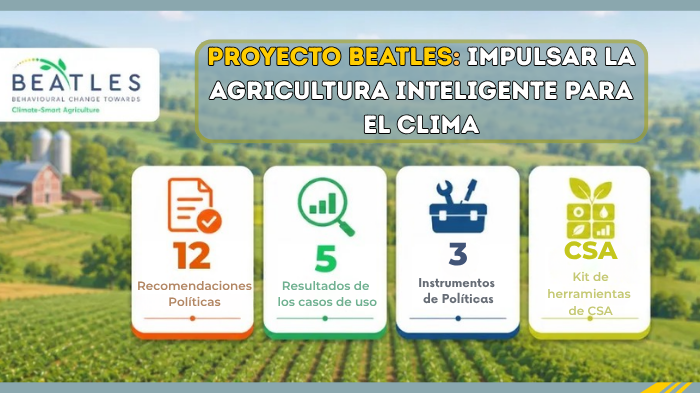
- The project has developed 12 policy recommendations and a toolkit to support the design, implementation and monitoring of climate-smart agriculture measures
- Spain participates through a use case in Navarre, focused on organic apple production and the development of a value chain capable of responding to the demand for organic fruit.
The transition to agri-food systems better adapted to climate challenges depends not only on the availability of new technologies or agricultural practices. It is also shaped by the decisions of farmers, businesses, consumers, government agencies, and other stakeholders in the value chains. This is precisely the starting point of the BEATLES project , funded by the Horizon Europe program. of the European Union (EU), which between 2022 and 2026 has analyzed how behavioral, economic, social, institutional and political factors influence the adoption of practices of " Climate smart agriculture" (CSA) , promoted by the FAO and the World Bank .
Through five case studies in different agricultural systems and European regions, the project has identified barriers, motivations, and conditions that can facilitate change. This knowledge has been translated into policy recommendations, tools, and resources designed to help policymakers, administrations, management authorities, and advisory bodies facilitate the transition to more climate-friendly production models.
What is climate-smart agriculture?
Climate-smart agriculture—promoted by the FAO and the World Bank —is an approach aimed at advancing agricultural systems capable of combining productivity, adaptation to climate change, and the reduction of greenhouse gas (GHG) emissions . Its principles are aligned with the objectives of the Common Agricultural Policy (CAP) , the European Green Deal , and the Farm to Fork strategy . The approach is structured around three pillars:
Productivity: to sustainably improve agricultural productivity, food security, farm viability and rural livelihoods.
Adaptation: strengthening the capacity of agricultural systems, territories and value chains to cope with climate variability and extreme events.
Mitigation: reducing GHG emissions through greater resource efficiency, carbon capture and proper land management.
BEATLES: Understanding what facilitates change
This is the approach taken by BEATLES, a project that has placed behavioral change and the transition of agri-food systems at the heart of its research. To this end, it has studied different European value chains and contexts with the aim of identifying the factors that can hinder or promote the adoption of sustainable agriculture practices. Its objectives include:
Analyze the factors that facilitate or hinder the transition to climate-friendly practices.
Evaluate the environmental and socioeconomic impacts of the proposed interventions.
Develop business strategies that facilitate the transition.
Formulate policy recommendations and tools to promote long-term behavioral changes.
Involving different actors in the value chains in the joint creation of transformation pathways.
Navarre, the Spanish case focused on organic apples
Among these five cases is Spain, through INTIA , with a study focused on organic apple production in Navarre . The region has favorable agronomic conditions for fruit production, although the level of self-sufficiency remains low, at 57% according to data collected by the project.
The case of Navarre begins with a situation where a significant area is dedicated to organic production, but difficulties persist in meeting the demand for organic fruit with local production. Among the main challenges identified are:
Organic fruit production in Navarre is not enough to meet the existing demand .
Some of the locally produced organic fruit is transported to other regions .
The lack of adequate storage facilities is one of the main difficulties for organic producers.
There is a lack of awareness among consumers about organic production methods.
In some cases, consumers show some reluctance to pay a higher price for organic fruit.
Faced with these challenges, the Spanish case includes different practices and tools linked to organic production and the use of technology:
Plant covers.
Zero waste strategies.
Hail and pest resistant nets .
Sexual confusion techniques.
An app for alert stations for pest and treatment alerts.
The crop proposed by BEATLES is to contribute to the establishment of an organic apple value chain in Navarra, favoring an increase in the area dedicated to this crop.
Four cases to analyze the transition in Europe
Alongside the Spanish case, BEATLES has worked with four other agri-food systems:
Lithuania – wheat: the project analyzes difficulties such as the costs of digital equipment and tools, limited access to technology and resistance to change, along with precision farming practices, crop rotation or cover crops.
Germany – organic dairy production: the case addresses the economic viability of farms, the effects of climate phenomena and the demand for organic products, with special attention to organic farming, livestock longevity and improved forage utilization.
Denmark – pig farming: studies how to improve competitiveness and reduce the environmental footprint through solutions such as using manure to produce biogas, feeding with local proteins, renewable energies or sensors to control emissions.
The Netherlands – potatoes and onions: the case study analyzes how to adapt to the climate through improvements in soil quality, water use efficiency and the use of smart farming technologies.
Twelve recommendations to promote climate-smart practices
Based on the evidence gathered during the project, BEATLES has developed 12 EU-level policy recommendations , specifically focused on the future CAP framework beyond 2027 and the National and Regional Partnership Plans for the period 2028-2034 . Key proposals include:
Improve the territorial coherence of CSA-related policies.
Strengthen support for farmers and vulnerable territories.
Incorporate behavioral approaches to promote the adoption of CSA practices.
Ensure sufficient financial support .
Simplify the CAP to facilitate the adoption of these practices.
Strengthen knowledge, innovation and advisory systems .
Integrate digitization as a support infrastructure.
Develop monitoring systems with territorially disaggregated information.
In addition, the BEATLES project has developed a policy toolkit for the adoption of climate-smart agriculture, aimed at policymakers, managing authorities, governance bodies and technical assistance agents.