





18 de September de 2026
Cambio climático y gestión de recursos naturales
Biodiversidad y paisaje
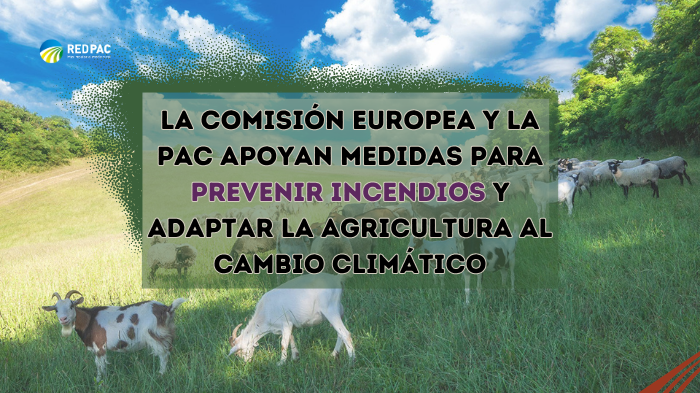
The European Commission, through the Common Agricultural Policy, supports measures to adapt agriculture to climate change and prevent forest fires.
- The European Commission, through the Common Agricultural Policy, supports measures to adapt agriculture to climate change and prevent forest fires.
- Extensive grazing, agroforestry, and permanent crops can help prevent and reduce the spread and intensity of fires
- The proposal for the future CAP maintains support for fire prevention and forest restoration, extensive grazing and agroecological models in the face of fire
The increasing frequency and intensity of wildfires and extreme weather events such as droughts and heat waves are putting increasing pressure on European farmland and forests. From January 1 to August 25, 2026, more than 620,000 hectares burned in the European Union (EU) , an area that is double the annual average recorded for this time of year between 2006 and 2025. Spain accounts for approximately 295,000 hectares burned, followed by France with 96,000, and Italy with 91,000.
Given this scenario, the European Commission (EC) proposes a risk management approach that goes beyond simply reacting to fires after they have already broken out. Prevention also involves maintaining active and well-managed agricultural and forestry systems, reducing biomass accumulation, and conserving mosaic landscapes. In this context, farmers, livestock breeders, and forest owners play a crucial role throughout the entire fire management cycle: from prevention and preparedness to response and subsequent restoration.
Agriculture and land management against fire
Agricultural activity can contribute to reducing the risk of wildfires through practices that maintain the managed landscape and limit the amount of vegetation that can act as fuel. Among the main actions proposed by the EC are:
Maintaining mosaic agricultural landscapes , which interrupt continuous surfaces of vegetation and can slow the spread of fire.
Promote grazing , especially extensive grazing, to control the presence of scrubland that can fuel fires.
Develop agroforestry and silvopastoral systems , combining trees, crops and/or livestock to reduce dry vegetation and prevent land abandonment.
Maintain permanent crops , such as vineyards and olive groves, which can act as firebreaks when well managed.
Apply controlled burns , when appropriate and always under strict conditions and with the support and authorization of the authorities and specialized professionals.
The EC also highlights that the presence of farmers and forest owners in rural areas can contribute to early detection and emergency response, thanks to resources such as machinery, water storage, and local knowledge. Following a fire, their involvement is equally important for the recovery of affected lands and landscapes.
A better prepared forest management
Fire prevention also requires direct action in forest areas. The EC proposes the following measures:
Thinning, pruning and management of soil vegetation to reduce excess biomass.
Removal of dead wood , applying criteria that take into account the protection of ecosystems.
Prescribed burns , when appropriate, to remove dead vegetation and undergrowth.
Maintenance of strategically located forest firebreaks .
Improvement of infrastructure and equipment , such as roads, water points, reservoirs, dams and watchtowers.
Diversification of forest species and structures , through mixed stands and species less prone to fire when conditions allow.
Restoration of land affected by fires, including erosion control, support for natural regeneration and replanting where necessary.
How the CAP supports fire prevention
The Common Agricultural Policy (CAP) is one of the main European funding channels for the prevention of forest fires on agricultural and forest land:
Preventive investments in agriculture and forestry to reduce the effects of natural disasters.
Restoration of agricultural and forestry productive potential after a disaster.
Payments for environmental and climate commitments that support practices such as grazing, agroforestry or biomass control.
Risk management tools , including insurance and compensation after major losses.
Training, advice and cooperation to promote adaptation and prevention.
Furthermore, the EC points out that, within the EU's future financial framework, the CAP proposal maintains current funding opportunities for prevention and restoration and strengthens support for extensive grazing, including transhumance, as well as for more sustainable and fire-resistant agroecological models.
Adapting agriculture to heat waves
Extreme weather events, especially heat waves and droughts, are becoming more frequent and severe in Europe. The European Commission notes that crop losses caused by droughts and heat waves have tripled in the last 50 years. Heat stress affects both crop development and the welfare and productivity of livestock.
To address these effects, the EC proposes combining immediate measures with changes in farm management and medium- and long-term investments:
In crops:
Better manage water resources through efficient irrigation systems, storage, water reuse, and natural retention measures.
Improve soil health by maintaining its cover, reducing tillage, and increasing organic matter to conserve moisture.
Adapt and diversify crops , selecting varieties that are more resistant to heat and opting for crops tolerant to high temperatures.
Protect crops from the heat , using solutions such as multifunctional nets, covers or certain pruning practices.
In livestock farming:
Ensure clean, fresh water and adapt the supply points to the needs of the animals.
Provide shade and improve the conditions of the facilities, especially in grazing and resting areas.
Adapt livestock management by adjusting feeding times and reducing, where possible, the density of animals in indoor spaces.
Move towards more resilient systems , such as agroforestry and silvopastoral systems, and conserve locally adapted livestock breeds.