




17 de December de 2025
Resiliencia y competitividad
The "Present and Future of the Potato" conference brought together the sector to address plant health, innovation and the resilience of this crop
- The "Present and Future of the Potato" conference brought together the sector to address plant health, innovation and the resilience of this crop
- Farmers, cooperatives, industry and distribution participated in a technical program focused on this sector
Spain currently holds a prominent position in the European and global potato market. Our country is the 7th largest producer in Europe , in a market dominated by Germany, France, the Netherlands, and Poland, which together account for 61% of the total value of potato production in the European Union (EU). Globally, production is concentrated in China, India, and the EU itself, making this tuber a strategic pillar of the international food system.
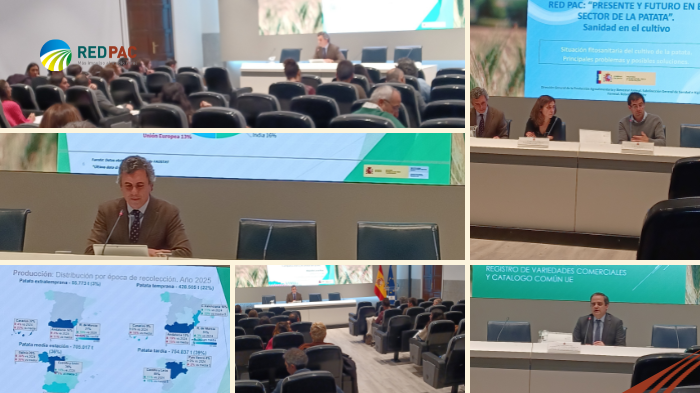
Against this backdrop, the informative event “Present and Future in the Potato Sector,” organized by the CAP Network , took place on December 1, 2025, in the Auditorium of the Ministry of Agriculture, Fisheries and Food (MAPA) . The meeting, held in a hybrid format—both in person and via a live stream on YouTube—brought together producers, cooperatives, industry representatives, distributors, and professionals interested in the sector's evolution, with 52 people attending in person and 175 participating virtually.
Developed through a fully technical approach, the conference addressed the main challenges and opportunities of potato cultivation, from plant health to digitalization, varietal innovation, and product promotion. The discussions took place within a context marked by the need to strengthen resilience, improve competitiveness, and consolidate sectoral cohesion.
The potato in Spain
The technical analysis of the day was based on a series of recent indicators that allow us to understand the evolution of the sector and the territorial differences in cultivation. In the national context:
Spanish production grew by 52% in 2024, driven by better yields.
Forecasts for 2025 point to a slight decrease of 1.9% .
In irrigated potato cultivation, Castile and León, Andalusia, the Region of Murcia, and the Valencian Community stand out; in dryland farming , Galicia; and the Canary Islands, although with its own particularities, also produce irrigated potatoes. Based on this territorial distribution, the regional analysis reveals marked differences between potato varieties and production areas:
Extra-early potatoes : register declines in the Canary Islands and Andalusia and growth in the Region of Murcia despite still being below the average.
Early potatoes : remain stable in the Canary Islands, fall in Andalusia and show notable increases in the Region of Murcia and the Valencian Community.
Mid-season potato : shows sharp declines in Galicia and moderate increases in Castilla y León and Andalusia.
Late potatoes : Castilla y León accounts for most of the production and is improving both compared to the 2024 data and the average.
Objectives of the day
Throughout the session, the three main themes of the day were addressed:
Promoting sustainability, digitalization and innovation in farming systems.
Discussing the challenges of the market and plant health , especially relevant for the 2024/25 season.
Promoting potato consumption and strengthening sector cohesion is key to improving the product's position in households and in the HORECA channel (Hotels, Restaurants and Cafeterias).
Speakers
Following the pattern of other technical conferences organized by the CAP Network, such as the one held at the Expo Sagris Fair , the program featured civil servants from different units of the MAPA who offered an applied and data-driven perspective:
Alejandro Lorca, Deputy Director General of Fruits, Vegetables, and Viticulture, opened the technical session with a characterization of the sector and the context of the last season, analyzing trends, production, and the market situation. His presentation provided insight into the current state of the crop and the factors influencing its competitiveness.
Roberto Sanz, head of the Phytosanitary Coordination Service, addressed the phytosanitary situation of the crop, detailing the main problems, emerging risks, and possible solutions. Blanca Ramón, from the General Sub-Directorate of Sanitary Agreements and Border Control, added her perspective, explaining border controls and access to markets such as the United Kingdom and the Canary Islands, a key aspect for traceability and plant safety in marketing.
José Antonio Sobrino, Deputy Director General of Agricultural Production Resources and head of the Spanish Plant Variety Office, presented the role of seed potatoes in the profitability of the crop, advances in new varieties , the issue of the green potato and the opportunities opened up by new genomic techniques to improve productivity and resistance to new pests.
Sebastián Sangro, from the General Sub-Directorate of Irrigation, explained the evolution of digitalization in potato cultivation and the advances in irrigation systems , highlighting how technology can improve water efficiency and the sustainability of the crop.
Purificación González, Deputy Director General of Food Promotion of Spain, concluded the presentations by analyzing potato consumption in households and in the HORECA channel, as well as the promotion and communication strategies of the Spanish origin, fundamental to strengthening demand and sector cohesion.
The day concluded by highlighting the strategic importance of potato cultivation for the Spanish agri-food system and the need to continue advancing in innovation, sustainability, and cooperation. With a comprehensive program and expert speakers, the meeting provided an opportunity to analyze current challenges and the keys to building a more competitive, profitable, and cohesive future for the potato sector.