





21 de October de 2026
Innovación
Calidad y cadena alimentaria
Resiliencia y competitividad
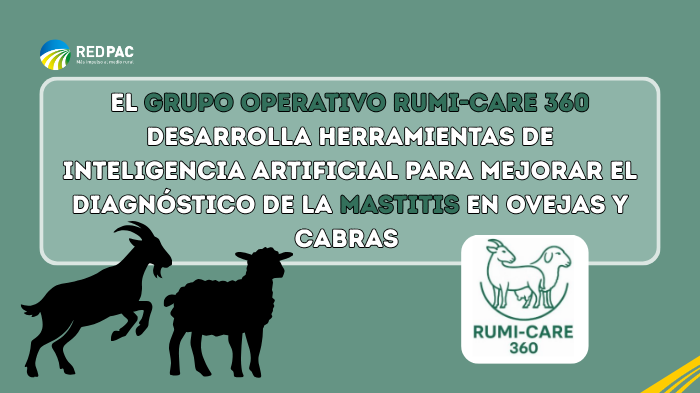
The RUMI-CARE Operational Group was established to improve mastitis prevention in sheep and goats.
- The RUMI-CARE Operational Group was established to improve mastitis prevention in sheep and goats.
- The research works with five sheep and goat breeds to develop predictive models and advance genetic selection
- A web application will facilitate access for the livestock sector to risk assessments and health management recommendations
Mastitis is one of the main health problems in dairy sheep and goat farms, as it can reduce production, increase veterinary costs, and affect animal welfare. Its prevention requires considering multiple factors, from management practices and milking routines to the animals' characteristics and genetic predisposition.
To address this challenge, the Operational Group (OG) RUMI-CARE 360 employs a multidisciplinary approach that integrates artificial intelligence, milk analysis, and new diagnostic techniques. The project aims to develop practical tools that allow for anticipating the risk of mastitis, improving its control, and facilitating decision-making on farms. According to the National Association of Breeders of Florida Goats (ACRIFLOR) , “the overall objective of the RUMI-CARE 360 project is to develop a multidisciplinary approach to improve the prevention, diagnosis, and control of mastitis in small dairy ruminants.”
Artificial intelligence to improve diagnosis
The GO RUMI-CARE 360 combines different technologies to study breast health and detect potential risk factors. Its main lines of work are:
Artificial vision: analysis of images and videos during milking to evaluate udder morphology using artificial intelligence.
Infrared thermography: measuring the temperature of the udder and the eye region to study possible signs of inflammation and stressful situations.
Milk analysis: total and differentiated somatic cell count and microbiological analysis to identify indicators related to mammary health and detect possible pathogens.
Predictive models: integration of health, production, environmental and genetic information to estimate the risk of mastitis in animals and herds.
These technologies will be validated on commercial farms to evaluate their performance under real conditions and to adapt them to the characteristics of different breeds and management systems.
Five breeds to study risk factors
The project brings together five native sheep and goat breeds to analyze the disease, taking into account their specific production and health characteristics:
Florida, Payoya and Palmera, goat breeds.
Manchega and Grazalema merino sheep breeds.
The work includes gathering information on milking routines, reproductive and production management, environmental conditions, and the evolution of somatic cell counts. This data will be used to identify risk factors and develop genetic assessment criteria for disease resistance and resilience, with a view to incorporating them into breeding programs.
Advances in the characterization and monitoring of animals
The project is still in its implementation phase and has already made progress in characterizing the participating farms. According to ACRIFLOR, “the farms have already been characterized from the perspective of milking management, reproductive, productive, and environmental management, as well as the evolution of somatic cell counts in recent years for each of the breeds in the project.” Currently, the work is focused on:
Develop genetic assessment methodologies to study the predisposition to mastitis and resilience to the disease.
Select reference farms and animals for monitoring from birth to drying off. This phase has already begun with the Florida and Manchega breeds.
Implement systematic monitoring of animals in the Florida and Manchega breeds, with environmental records, information on milking routines, images, thermographic measurements and milk samples to analyze somatic cells and detect possible pathogens.
The selection of animals for the other three breeds is scheduled to be completed before the end of 2026, according to the planning provided by the project.
A web application to support livestock management
Another objective of the GO is to develop a web application connected to the information systems of the participating associations. The platform will allow users to consult the research results and facilitate their practical application on farms. Its planned functions include:
Consult estimates of mastitis risk per animal.
Access recommendations to improve health management.
Using genetic information to support the selection of replacement animals.
Participants and funding
The project is coordinated by ACRIFLOR and has the collaboration of:
National Association of Breeders of Select Manchega Breed Sheep (AGRAMA) .
Association of Breeders of the Merino Breed of Grazalema (AMEGRA) .
Foundation Center for Research and Agri-food Quality of the Pedroches Valley (CICAP) .
Regional Center for Animal Selection and Reproduction of Castilla-La Mancha (CERSYRA-IRIAF) .
The GO RUMI-CARE 360 project has a budget of €598,007 and will run from 2025 to 2029, with a supra-regional scope in Andalusia and the Canary Islands. It is co-financed 80% by the European Agricultural Fund for Rural Development (EAFRD) and 20% by the Spanish Ministry of Agriculture, Fisheries and Food (MAPA) , within the framework of the Strategic Plan for the Common Agricultural Policy (PEPAC) 2023-2027 .