





23 de July de 2026
Innovación
Cambio climático y gestión de recursos naturales
Calidad y cadena alimentaria
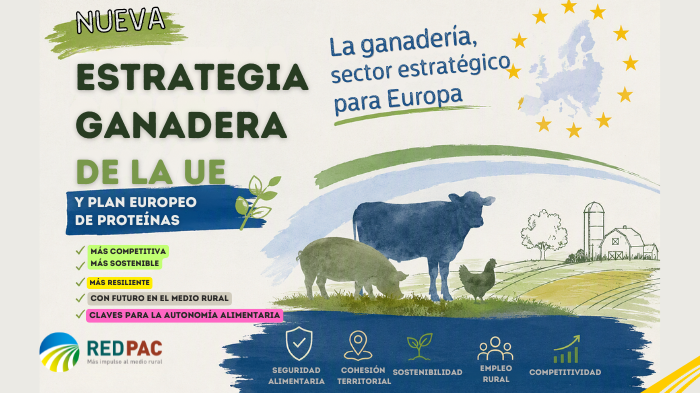
Brussels positions the livestock sector as a strategic activity for food security, territorial cohesion and European competitiveness
Brussels positions the livestock sector as a strategic activity for food security, territorial cohesion and European competitiveness
The new roadmap sets out five priorities for action and aims to reduce external dependence on plant proteins through increased community production.
The European Commission ( EC ) has taken a significant step in shaping the post-2027 agri-food policy with the presentation of the first European Union Livestock Strategy and a European Protein Plan . Both instruments recognize the strategic importance of the livestock sector for food security, rural employment, territorial cohesion, and European strategic autonomy, while also establishing a roadmap to improve its resilience, competitiveness, and sustainability in a context marked by geopolitical uncertainty, climate change, and market volatility.
The new strategy, presented by the European Commission on July 7, is based on a clear diagnosis: European livestock farming faces significant challenges stemming from rising production costs, regulatory pressure, outbreaks of animal diseases, extreme weather events, and insufficient profitability on many farms. According to Brussels, this situation has contributed to a continued decline in livestock numbers in several sectors over the past few decades.
At the same time, the Commission underlines the economic and social importance of livestock farming in the European Union. The sector represents around 40% of European agricultural value added, generates annual revenue of nearly €400 billion, supports approximately seven million jobs, and relies on some four million farms distributed throughout the EU.
Five priorities for the future of European livestock farming
The European Strategy for Livestock is structured around five major priorities.
The first step involves building a more resilient and crisis-prepared sector by strengthening risk management tools, developing insurance mechanisms, and improving the capacity to prevent and respond to animal diseases. The Commission also plans to work with the European Investment Bank to enhance hedging tools against climate and health risks.
The second priority aims to foster a more competitive and profitable sector by promoting innovation, digitalization, and new revenue streams for farms. Brussels also emphasizes the importance of strengthening producers' position in the value chain and promoting reciprocal standards in international trade.
The third focus is on environmental sustainability and animal welfare . Planned measures include revising certain animal welfare standards, developing harmonized methodologies for calculating emissions from farms, and promoting livestock systems adapted to the characteristics of each region.
The fourth priority aims to ensure viable livestock farming in all European regions , especially in areas vulnerable to land abandonment and depopulation. In this area, the Commission wants to strengthen extensive livestock farming systems, support small-scale slaughterhouses, and bolster local value chains.
Finally, the strategy aims to reinforce the excellence of European production , through better valuing the high community standards in quality, food safety, animal welfare and sustainability, as well as through strengthening labelling and promotion systems.
A European Protein Plan to reduce dependencies
Alongside the livestock strategy, the Commission has launched a European Protein Plan aimed at reducing dependence on imports of raw materials for animal feed.
Currently, only a limited portion of the protein from oilseeds and protein crops consumed in the EU is produced within its borders. Therefore, Brussels is proposing to significantly increase EU production and raise protein self-sufficiency to 35% by 2035 , strengthening the link between agriculture, food, the bioeconomy, energy, and industry.
The Commission believes that this initiative will contribute to strengthening European strategic autonomy in the face of potential geopolitical and trade disruptions, as well as generating new economic opportunities for farmers and livestock breeders.
The MAPA highlights profitability as a condition for success
From Spain, the Minister of Agriculture, Fisheries and Food, Luis Planas, has positively assessed both the European Strategy for Livestock and the European Protein Plan.
Regarding the protein plan, Planas pointed out that it constitutes an essential tool to strengthen the strategic autonomy of the European Union in a context characterized by geopolitical uncertainty and the volatility of international markets.
Regarding the livestock strategy, the minister considers it a “necessary and timely” initiative to address the significant challenges facing a sector that is strategic for food security, territorial balance, and the rural economy. He also emphasized that the success of both initiatives must be based on an approach that guarantees the profitability of European farmers and livestock breeders.
A document with an impact on the debate on the CAP post-2027
The new European Strategy for Livestock comes at a crucial moment for the future of European agriculture. Beyond the specific measures announced, the document reinforces the idea that livestock farming will continue to be a strategic activity for the European Union and an essential element for food security, land management, biodiversity, the rural economy, and the EU's strategic autonomy.
Its development over the next few years and its eventual integration into the future CAP will shape much of the European agricultural debate on competitiveness, sustainability and generational renewal in rural areas.
“Farm Europe”: an opportunity to regain weight in livestock farming in Europe
The strategy's presentation has also been praised by European agri-food organizations. In this regard, the think tank Farm Europe considers the document a significant shift in the EU's approach to livestock farming, explicitly recognizing its strategic role in food sovereignty, the economic vitality of rural areas, and the Union's territorial resilience.
The organization particularly emphasizes that Brussels is once again placing farm animals at the center of the European agri-food system and demands that the strategy now translate into concrete instruments, sufficient funding and measures capable of halting the continued loss of livestock recorded in numerous Member States in recent years.
Sources: European Commission (EU Strategy for Livestock and European Protein Plan), Spanish Ministry of Agriculture, Fisheries and Food (MAPA) and Farm Europe.