





18 de August de 2026
Innovación
Resiliencia y competitividad
Biodiversidad y paisaje
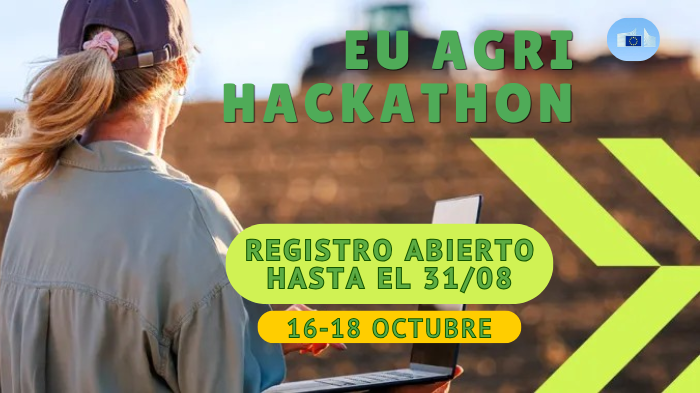
The first edition of the EU Agri-Hackathon will be held entirely online from October 16-18, 2026, and will bring together participants from different fields to develop digital tools aimed at the agricultural sector.
- The first edition of the EU Agri-Hackathon will be held entirely online from October 16-18, 2026, and will bring together participants from different fields to develop digital tools aimed at the agricultural sector.
- The challenge is structured around three lines: reducing the administrative burden, facilitating the use of farm data, and improving information exchange.
- The deadline for submitting applications will remain open until August 31st at 12:00 pm
The European Commission (EC) , through the Directorate-General for Agriculture and Rural Development (DG AGRI) , is organizing the first edition of the EU Agri-Hackathon , an innovation event that aims to develop digital solutions to address the specific needs of European farmers. The event will be held virtually from October 16 to 18, 2026 , and will bring together professionals from the fields of agriculture, technology, research, business, and public policy.
For 48 hours, teams will work collaboratively with the support of mentors and access to agricultural data to transform various challenges in the sector into practical digital solutions. The initiative stems from a common idea shared by the three challenges : simplifying agricultural activity and reducing the complexity associated with administrative obligations, data management, and information sharing within the agri-food chain.
An open call for diverse profiles
The EU Agri-Hackathon aims to bring together diverse knowledge and experiences to address challenges from different perspectives. Participation is open to individuals as well as pre-formed teams . Potential participants include:
Professionals in the agri-food sector.
Students, researchers, and entrepreneurs.
Data analysts and developers.
Technology and IT professionals.
Specialists in economics, business strategy and statistics.
Experts in agriculture, environment and agricultural policies.
Participating teams will consist of three to four people , and a combination of different areas of expertise will be especially valued. Where possible, teams will also include at least one member with a specialization in agriculture.
To participate, you must be a citizen of a European Union (EU) Member State, a legal resident, or be studying in one of them, be at least 18 years old, and have a sufficient level of English to participate in the sessions and present the project.
Three challenges to simplify agricultural activity
All teams will work towards the common goal of reducing the complexity currently faced by farmers. To this end, they can indicate during registration which challenge they prefer to address.
Less time with forms, more time on the farms
The first challenge is to transform manual, complex, and fragmented administrative processes into simpler, automated, and integrated information systems. The solutions should contribute to:
Reduce the bureaucratic burden .
Simplify administrative tasks .
Automate report generation processes .
Facilitate compliance with existing obligations .
More useful information for simpler farming
The second challenge focuses on the amount of data currently generated by farms through sensors, connected machinery, and other precision agriculture technologies. In this case, the aim is to find tools that allow for:
Simplify data collection and analysis.
Transforming large volumes of information into useful knowledge for decision-making.
Facilitate the management of data generated on farms.
Leverage technologies such as sensors, devices, and connected machinery.
Data flowing to improve collaboration
The third challenge focuses on information exchange among the various actors in the agri-food value chain. The objective is to develop platforms or tools that facilitate this communication and help professionals in the agricultural sector strengthen their position. Proposals may focus on:
Simplify the exchange of information with other agents in the chain.
Facilitate access to new sales opportunities .
Improve the determination of product value .
Promote agreements and collaborations.
Keeping farmers in control of their own data .
From idea to prototype
The hackathon will not be limited to the presentation of proposals. At the end of the 48-hour work period , each team must deliver a clear and concise presentation explaining the problem addressed, the proposed solution, its feasibility and potential impact, as well as develop a prototype, code, or functional demonstration.
The organization also encourages participants to develop demonstrable and reusable solutions and publish them under an open-source license. Solutions created during the event will remain the intellectual property of the teams that develop them.
Dates and participation
Registration for the EU Agri-Hackathon 2026 is open until August 31, 2026, at 12:00 PM . Participant selection and team formation will take place in September. The main dates for the event are:
August 31, 2026 : Registration deadline ends.
September 2026 : selection of participants and formation of teams.
October 2026 : Virtual team-building session.
October 16-18, 2026 : EU Agri-Hackathon celebration and development of solutions.
December 8-9, 2026 : Awards ceremony during the EU Agri-Food Days 2026 .
Learn more details and explore the documents at the web event .