





31 de July de 2026
Innovación
Cambio climático y gestión de recursos naturales
Calidad y cadena alimentaria
Resiliencia y competitividad
The Red PAC event “Presentation and exchange of experiences of good practices of OPFH and AOPFH” highlighted the strategic role of producer organizations in promoting innovation, sustainability and the concentration of supply in Spain
The Red PAC event “Presentation and exchange of experiences of good practices of OPFH and AOPFH” highlighted the strategic role of producer organizations in promoting innovation, sustainability and the concentration of supply in Spain
The report on operational programs of OPFH and AOPFH published by the CAP Network includes 14 inspiring experiences that show the impact of cooperation in the fruit and vegetable sector
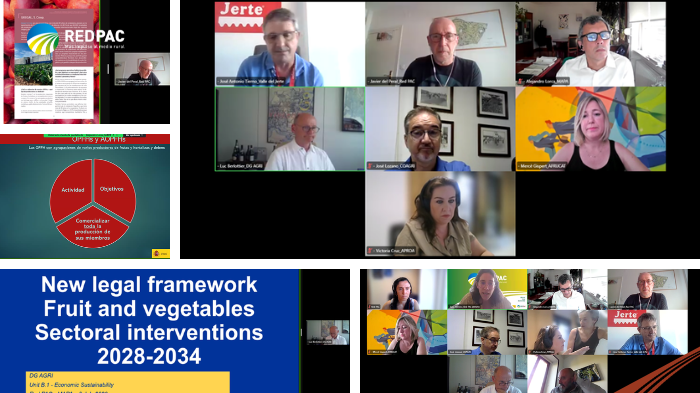
Fruit and vegetable producer organizations (FPOs) and their associations (FPO Associations) continue to consolidate their position as one of the most effective tools of the Common Agricultural Policy ( CAP ) for improving the competitiveness, sustainability, and adaptability of the fruit and vegetable sector. With this objective, the CAP Network held the virtual seminar “ Presentation and Exchange of Best Practices of FPOs and FPO Associations ” on July 9th. Representatives from the Ministry of Agriculture, Fisheries and Food ( MAPA ), the European Commission ( EC ), and various producer organizations participated in the event to share success stories and analyze the challenges that will shape the future of the sector.
A forum to share knowledge and strengthen the fruit and vegetable sector
The event, organized by the CAP Network, brought together representatives of OPFH and AOPFH from across the country, public managers, cooperatives, agricultural professional organizations and people interested in the development of a more competitive and sustainable fruit and vegetable activity.
The meeting had a dual objective: on the one hand, to present the new Report on operational programs of fruit and vegetable producer organizations (OPFH) and their associations (AOPFH) ; and on the other hand, to generate a space for reflection on the role that these entities currently play and will play in the next European framework.
The publication presented by the CAP Network compiles and analyzes experiences developed by 14 Producer Organizations and Associations of Producer Organizations , showing how the operational programs implemented within the framework of the sectoral intervention for fruits and vegetables are contributing to responding to challenges as relevant as environmental sustainability, technological innovation, adaptation to climate change or the improvement of the profitability of farms.
Associations as a driver of innovation and competitiveness
Among the main conclusions of the Report, the value of cooperation in transforming individual challenges into collective opportunities stands out.
The experiences analyzed show that OPFH and AOPFH make it possible to promote joint investments, develop applied research projects, improve production and marketing processes, optimize the use of resources and favor the incorporation of new technologies into the sector.
The publication also highlights how these organizations contribute to strengthening the position of producers in the food chain, an issue that is especially relevant in a context marked by market volatility, increased production costs and the effects of climate change.
Producer Organizations (POs), a key component of the CAP in the fruit and vegetable sector
During the day, Alejandro Lorca Ruiz, Deputy Director General of Fruits and Vegetables and Viticulture of the MAPA , presented the current situation of the sectoral intervention of fruits and vegetables within the Strategic Plan of the CAP 2023-2027 (PEPAC ).
In his speech he highlighted that the Producer Organizations (POs) are one of the main instruments for production planning, supply concentration and market orientation, contributing decisively to achieving the CAP objectives.
Currently, Spain has 450 fruit and vegetable producer organizations and 12 associations of producer organizations , entities that concentrate approximately 50% of the national fruit and vegetable production and that place the country as a European leader both in production and in the execution of operational programs.
The growing economic importance of these instruments was also highlighted. Aid channeled through operational programs has seen significant growth in recent years, reaching figures exceeding €300 million annually from the European Agricultural Guarantee Fund ( EAGF ).
The European horizon 2028-2034: continuity and new opportunities
One of the most important moments of the day was the presentation of the main lines of work that the European Commission is considering for the future regulatory framework of the CAP and the sectoral interventions for fruits and vegetables for the period 2028-2034.
Luc Berlottier, senior expert and coordinator of Sectoral Interventions at the Directorate-General for Agriculture and Rural Development ( DG AGRI ), explained that producer organizations will continue to occupy a central position within the future architecture of support for the sector.
Among the proposed changes are the strengthening of measures focused on innovation, research, risk management, climate adaptation and generational renewal, as well as greater administrative simplification and a clearer focus on results.
The European proposal also maintains the strategic nature of operational programs as the main tool for implementing sectoral interventions in fruits and vegetables, consolidating the role of Producer Organizations (POs) and Associations of Producer Organizations (AOPOs) as key agents to address the economic, environmental and social challenges of the coming decades.
Real-world experiences to build the future of the sector
The day concluded with a round table discussion in which representatives of the organizations included in the Report participated, along with officials from the MAPA and the European Commission.
During the debate, experiences related to sustainability, innovation, marketing and cooperation among producers were shared, highlighting that the exchange of knowledge continues to be one of the most effective tools to promote the modernization of the sector.
With initiatives like this, the CAP Network reinforces its role as a meeting place, shared learning and generation of opportunities for agents in the rural and agricultural environment, promoting the dissemination of good practices that contribute to building a more competitive, resilient and future-ready fruit and vegetable sector.
The event is available on the PAC Network's YouTube channel .