





17 de September de 2026
Dinamización rural
Cambio climático y gestión de recursos naturales
Mujeres
Resiliencia y competitividad
The event brought together nearly 80 participants and focused on economic diversification, the creation of support networks, and the leading role of rural women in territorial innovation.
- The event brought together nearly 80 participants and focused on economic diversification, the creation of support networks, and the leading role of rural women in territorial innovation.
- Experts, entrepreneurs, and institutional representatives agreed on the need to simplify bureaucracy, strengthen the recognition of the sector, and generate new opportunities linked to the territory.
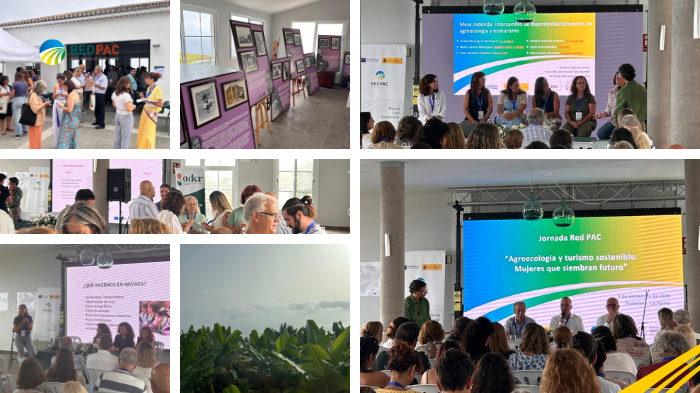
Agroecology, sustainable tourism, and women's leadership are becoming key tools for driving rural development. This was evident at the CAP Network conference. “Agroecology and sustainable tourism: Women sowing the future” , held on September 9 in La Palma, where innovative experiences of economic diversification in the agricultural sector were presented and proposals were shared to strengthen the role of rural women in building more sustainable, resilient and connected territories.
Organized by the CAP Network of the Ministry of Agriculture, Fisheries and Food (MAPA) , in collaboration with ADER La Palma , the event transformed the Ecofinca Nogales into a meeting place for farmers, livestock breeders, entrepreneurs, research staff, institutional managers and agents of the territory to discuss agroecology, ecotourism, environmental education and rural innovation.
Create a network to strengthen rural projects
One of the most repeated messages throughout the day was the importance of building collaborative networks between professionals and projects that share similar objectives.
The participants agreed that the exchange of knowledge, cooperation between initiatives and the creation of meeting spaces such as those promoted by the CAP Network are fundamental to facing the current challenges of the rural environment and to favoring the viability of new entrepreneurial projects.
The need to generate alliances and mutual support proved especially relevant in activities such as agroecology or sustainable tourism, where collaboration allows sharing experiences, identifying common solutions and multiplying the positive impact on the territory.
Less bureaucracy and more recognition for those who start businesses in rural areas
Another issue that was central to much of the debate was the need to simplify the administrative procedures faced by rural entrepreneurs.
The participants indicated that reducing bureaucratic burdens and streamlining administrative processes would help facilitate the implementation and consolidation of innovative projects related to agricultural activity, agri-food processing, environmental education, or ecotourism.
In addition, the importance of moving towards greater social and economic recognition of the work done by rural women was highlighted, both for their contribution to food production and for their ability to generate employment, retain population and revitalize the territory.
Agroecology and sustainable tourism: an opportunity to diversify farms
The event provided an opportunity to learn about various initiatives that have incorporated complementary activities to traditional agricultural production through ecotourism proposals, experiences linked to the territory, environmental education, or the enhancement of local products.
During the "Cultivating Territory: Agroecology, Heritage and Ecotourism for a Sustainable Rural Future" block, the speakers highlighted the potential of these models to generate new sources of income, bring the primary sector closer to the citizens and strengthen the link between environmental conservation and economic development.
It was also emphasized that diversification should not be understood as an alternative to agricultural activity, but as a complementary strategy that contributes to strengthening its long-term sustainability and viability.
New perspectives on the territory and ecotourism
The round table dedicated to the exchange of experiences in agroecology and ecotourism brought together projects from the Canary Islands, the Valencian Community and Andalusia who shared lessons learned, challenges and opportunities that arose during their trajectories.
Among the main conclusions highlighted the need to develop new narratives capable of bringing citizens closer to the rural environment from a more experiential, participatory perspective and connected with the environmental and cultural values of the territory.
The participants argued that ecotourism can become an effective tool for raising awareness, publicizing the value of agricultural activity, and strengthening the link between consumers and food producers.
The soil as a source of life
One of the most inspiring messages that emerged during the meeting was the invitation to reconsider the way agricultural soil is perceived.
The participants argued that soil should not be understood solely as a physical support on which to produce, but as a living element that generates biodiversity, food, ecosystem services, and development opportunities for rural communities.
This vision is linked to the principles of agroecology and to production models that seek to reconcile economic profitability with the conservation of natural resources.
Profitability and sustainability, two inseparable goals
Another idea shared by the entrepreneurs was that profitability and sustainability are not only compatible, but necessarily complementary.
The experiences presented demonstrated that it is possible to develop economically viable initiatives while protecting the environment, promoting biodiversity, and generating social value in the territory.
The participants agreed that environmental sustainability is now an essential condition to guarantee the future profitability of agricultural holdings and projects linked to sustainable tourism.
A practical visit to learn about on-the-ground experiences
The day concluded with a visit to the facilities of Ecofinca Nogales, where attendees were able to learn firsthand about an example of agroecological management and economic diversification linked to the territory.
This tour allowed us to put many of the issues discussed during the day into practice and reinforced one of the main objectives of the meeting: to learn from real experiences that are already contributing to transforming the rural environment.
The CAP Network, a meeting place for rural areas
With this initiative, the CAP Network continues to promote spaces for the exchange of knowledge and good practices that contribute to boosting innovation, sustainability and territorial cohesion.
The event held in La Palma highlighted that the leadership of rural women, agroecology, and sustainable tourism are some of the most promising ways to generate economic opportunities, strengthen the social fabric, and build a more dynamic future for rural areas.