





07 de July de 2026
Dinamización rural
Innovación
Cambio climático y gestión de recursos naturales
Mujeres
Calidad y cadena alimentaria
Resiliencia y competitividad
Biodiversidad y paisaje
The Common Agricultural Policy has supported the modernization of the agri-food sector, the boost to rural areas and the evolution towards more sustainable, innovative and competitive agriculture and livestock farming.
- The Common Agricultural Policy has supported the modernization of the agri-food sector, the boost to rural areas and the evolution towards more sustainable, innovative and competitive agriculture and livestock farming.
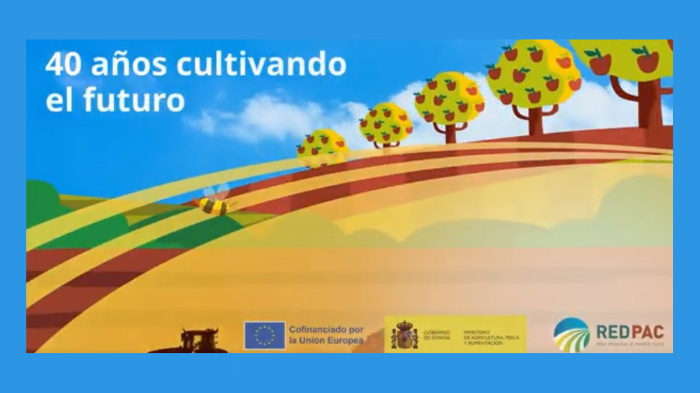
- The CAP Network joins this commemoration with the video “40 years cultivating the future” and with the key figures of a policy that is crucial for farmers, ranchers and rural areas
Forty years after Spain joined what was then the European Economic Community, the Common Agricultural Policy ( CAP ) remains a key driver of transformation in the Spanish countryside. It was created to guarantee food security, support the income of farmers and livestock breeders, and keep rural areas alive; today, it also promotes sustainability, combats climate change, fosters innovation, supports generational renewal, and supports territorial development. This four-decade commemoration not only invites us to look back, but also to reaffirm the CAP's role as a necessary policy for addressing the current and future challenges and opportunities facing the agri-food sector and rural areas.
Forty years ago, Spain made a decision that changed the course of its countryside: joining the then European Economic Community on January 1, 1986, opened the door to full participation in the Common Agricultural Policy, one of the major European policies aimed at the agricultural sector and rural areas.
To mark this anniversary, the Ministry of Agriculture, Fisheries and Food ( MAPA ) held an event on June 3, 2026, commemorating the 40th anniversary of the CAP in Spain, at which the publication “The Common Agricultural Policy: a triumph for Europe, a triumph for Spain. 40 years of the CAP in Spain 1986–2026” was presented .
From subsistence farming to an agri-food powerhouse
The evolution of Spanish agriculture over the past four decades is one of Spain's greatest stories of economic, social, and territorial transformation. According to data from the Ministry of Agriculture, Fisheries and Food (MAPA), Spanish agri-food has gone from a near-subsistence model to becoming a powerhouse in global markets, currently the fourth largest exporter in the European Union and seventh largest in the world.
The data clearly reflects this transformation. In 1986, Spain exported around €4 billion in agri-food products ; today, agri-food exports exceed €78 billion annually . Furthermore, Spain has gone from being the eighth largest exporter in the EU-12 to becoming the fourth largest exporter in the current EU-27.
This evolution is not only measured in foreign trade. The Ministry of Agriculture, Fisheries and Food (MAPA) also highlights that agricultural income has almost doubled since 1990, adjusted for inflation, and that the agri-food industry has increased its turnover eightfold in these 40 years, with a 51% increase in employment.
A policy to ensure food, income and life in the villages
In Spain, CAP subsidies represent approximately one-fifth of agricultural income, through the EAGF (European Agricultural Guarantee Fund) and the EAFRD (European Agricultural Fund for Rural Development). In the last year alone, around 580,000 farmers and livestock breeders have benefited from this policy, according to the commemorative video produced by the CAP Network.
In 2025, 22,065,086.16 hectares were declared under the CAP, corresponding to 582,085 individuals or entities . Although the area and number of applicants show a downward trend since 2014—with 10.4% less area and 33.8% fewer farms—these data also reflect a process of concentration of agricultural land and structural transformation of the sector.
Sustainability, innovation and rural development
The CAP has ceased to be solely a market intervention policy and has become a tool also geared towards sustainability, profitability, and innovation . The current 2023-2027 period reinforces this focus on concrete results, linked to a smart, competitive, resilient, and diversified agricultural sector.
One of the most noteworthy figures from the 2025 campaign is that 87% of the declared area is covered by some type of eco-scheme , which promotes more sustainable practices across a large agricultural area. This percentage has remained stable since the eco-schemes were implemented in 2023, fluctuating between 87% and 88%.
Furthermore, 29.6% of the total applications are linked to rural development aid, which promotes additional commitments in terms of sustainability, such as agri-environmental measures, organic farming, animal welfare or conservation of genetic resources.
Youth, women and generational change
Generational renewal is one of the major challenges facing the agricultural sector and one of the areas where the CAP has played a significant role. According to data compiled for this commemoration, CAP support has contributed to a 74.1% increase in young farmers between 2009 and 2020 , rising from 29,461 to 49,997 young farmers, according to the agricultural census.
In 2025, 8.4% of all CAP applicants will be young people . Of these, 22.3% are women and 69.6% are men. Furthermore, 9.5% of young people have applied for aid for organic farming and 20.1% for some type of agri-environmental practice.
The2023-2027 CAP maintains this impetus for generational renewal. In the first two years of the current period, National Reserve entitlements were allocated to 1,424 applications from young men and 661 from young women in 2023, followed by 1,105 applications from young men and 405 from young women in 2024, facilitating the entry of at least 3,640 young people.
The gender perspective is also part of the recent evolution of the CAP. In 2024, out of a total of 532,564 recipients , 37.6% were women and 8.9% were young people ; young women represented 2.2% of all recipients.
Forty years cultivating the future
The CAP Network summarizes this commemoration with a clear message: 40 years cultivating the future . The CAP has accompanied the modernization of Spanish agriculture, helped sustain incomes, farms, and villages, and promoted agricultural practices that favor biodiversity conservation and the fight against climate change.
Supporting agriculture is securing the future. And, after 40 years in Europe, the CAP continues to be a key policy for guaranteeing quality food, strengthening rural areas, and addressing the economic, environmental, and social challenges of the coming decades.